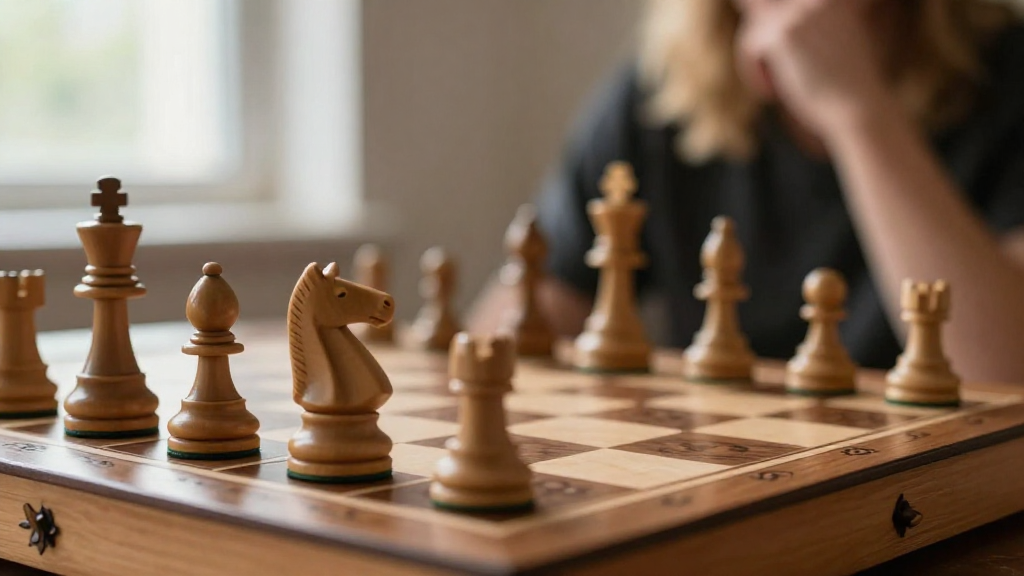
If you’ve ever wondered how to play chess, you’re in the right place! This beginner’s guide will walk you through the fundamental concepts of chess, enabling you to start your journey into this timeless game. Let’s dive in!
What is Chess?
Chess is a two-player board game that requires strategy, skill, and foresight.
The game is played on an 8×8 square board, known as a chessboard, with 64 alternating light and dark squares.
Each player commands an army consisting of 16 pieces:
- 1 King
- 1 Queen
- 2 Rooks
- 2 Knights
- 2 Bishops
- 8 Pawns
Understanding how each piece moves is crucial when you first learn how to play chess.
How Do the Pieces Move?
1. King
The King moves one square in any direction.
It’s the most important piece, and losing it means losing the game.
2. Queen
The Queen is the most powerful piece.
It moves any number of squares horizontally, vertically, or diagonally.
3. Rook
The Rook moves any number of squares, but only horizontally or vertically.
Each player starts with two Rooks.
4. Bishop
The Bishop moves diagonally for any number of squares.
Each player also has two Bishops, one on dark squares and the other on light squares.
5. Knight
The Knight has a unique L-shaped movement:
- It moves two squares in one direction and then one square at a right angle.
The Knight can jump over other pieces, which makes it versatile.
6. Pawn
Pawns move forward one square but capture diagonally.
On its first move, a Pawn can move two squares forward.
If a Pawn reaches the opposite side of the board, it can be promoted to any piece (usually a Queen).
What Are the Basic Rules of Chess?
1. Objective of the Game
The primary objective of chess is to checkmate your opponent’s King.
A checkmate occurs when the King is in a position to be captured (in check), and there are no legal moves to escape capture.
2. Starting the Game
When learning how to play chess, it’s essential to understand the initial setup:
- Place the Rooks in each corner of the board.
- Knights next to them.
- Bishops next to the Knights.
- The Queen is placed on her matching color (white Queen on white square, black Queen on black square).
- The King is placed next to the Queen.
- Lastly, arrange the 8 Pawns in the row in front of the pieces.
3. Turn Order
Players alternate turns, starting with White.
On your turn, you can move one piece according to its movement rules.
4. Capturing Pieces
If you land on a square occupied by an opponent’s piece, that piece is captured and removed from the board.
5. Check and Checkmate
If you place your opponent’s King in threat of capture, it’s called “checking” the King.
Your opponent must then make a move to get out of check.
If they cannot get out of check, it is checkmate, and the game ends.
6. Stalemate and Draws
A game can also end in a stalemate, where a player has no legal moves, yet their King isn’t in check.
There are other draw conditions, including insufficient material to checkmate and threefold repetition.
How to Practice and Improve Your Skills?
1. Play Regularly
The best way to learn how to play chess is by playing regularly, whether against friends or through online platforms.
2. Study Basic Strategies
Familiarize yourself with basic strategies:
- Control the center of the board.
- Develop your pieces (move them from the starting positions).
- Protect your King.
3. Solve Puzzles
Practice by solving chess puzzles online or in books.
Many puzzles focus on checkmates and tactical themes that can sharpen your skills.
4. Watch and Learn
There are countless YouTube channels and Twitch streams dedicated to chess.
Watching skilled players can provide valuable insights into advanced strategies.
5. Join a Chess Club
Consider joining a local chess club or participating in tournaments.
This experience can help you connect with other players and learn through competition.
What Are Some Common Chess Strategies?
1. Control the Center
Controlling the center of the board allows your pieces greater mobility and influence.
Aim to occupy central squares (d4, d5, e4, e5) with your pieces.
2. Develop Your Pieces
In the opening phase, prioritize development:
- Knights and Bishops should be moved toward the center.
- Avoid moving the same piece multiple times unless necessary.
3. Protect Your King
Ensure the safety of your King by castling early if possible.
Castling is a special move that involves the King and a Rook, enhancing the King’s safety while developing the Rook.
4. Plan Your Attacks
Always look for ways to threaten your opponent’s pieces while maintaining the integrity of your position.
Think ahead and plan your attacks carefully.
Where to Find Resources on Chess?
- Books: Many beginners’ chess books are available, covering everything from basic rules to advanced tactics.
- Websites: Platforms like Chess.com and Lichess.org offer tutorials, articles, and opportunities to play against others.
- Apps: There are numerous chess apps available for various devices that allow you to play anywhere, anytime.
Conclusion
Understanding how to play chess opens the door to centuries of strategic thought and enjoyment.
By mastering the pieces’ movements, familiarizing yourself with the rules, and practicing regularly, you can quickly improve your game.
Whether you envision yourself playing casually with friends or aiming for higher competitive play, the tips shared in this guide will help you embark on your chess journey.
Remember to enjoy the process, and with time and practice, you will develop your skills and enjoy this timeless game even more!
