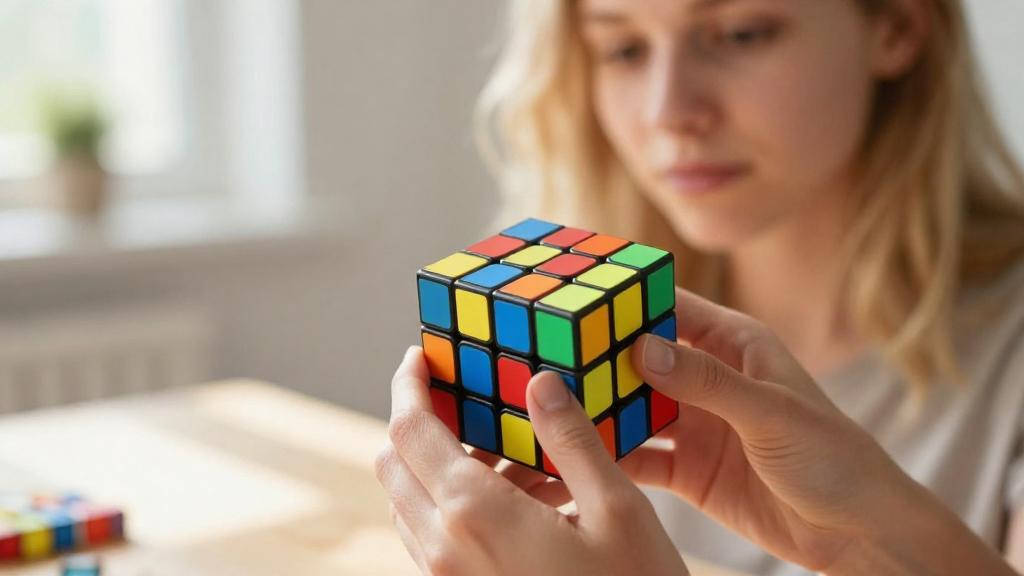
If you’re curious how to solve a Rubik’s Cube, you’ve come to the right place. This iconic puzzle can be daunting at first, but with the right techniques and a bit of practice, anyone can learn to solve it.
What Is a Rubik’s Cube?
The Rubik’s Cube is a 3D combination puzzle invented in 1974 by Hungarian architect Ernő Rubik.
This colorful cube consists of six faces, each made up of nine stickers of the same color.
The goal is to twist and turn the cube until each face shows a single color.
Why Learn How to Solve a Rubik’s Cube?
Learning how to solve a Rubik’s Cube is not only a fun challenge but also a great way to develop critical thinking and problem-solving skills.
Here are some reasons:
- Improves cognitive skills: Solving a Rubik’s Cube requires logical thinking and spatial reasoning.
- Enhances memory: Memorizing different algorithms can improve memory retention.
- Boosts concentration: The intricate moves demand focus, enhancing your overall attention skills.
What Are the Basics of the Rubik’s Cube?
Before diving into the steps of how to solve a Rubik’s Cube, it is important to understand the basic structure and terminologies associated with the puzzle:
- Faces: Each side of the Cube is called a face.
- Stickers: The colored squares on each face.
- Layers: The cube has three layers – top, middle, and bottom.
- Pieces: There are three types of pieces: corner pieces, edge pieces, and center pieces.
How Does the Rubik’s Cube Work?
Understanding how the cube functions can be helpful in solving it. Each piece can only move in specific ways, and the movement depends on the rotations of the layers.
The cube consists of:
- Center Pieces: Fixed and indicate the cube’s color.
- Edge Pieces: Pieces with two colors that sit between corners.
- Corner Pieces: Pieces with three colors located on the corners.
How to Solve a Rubik’s Cube: A Step-by-Step Guide
Now that you have a foundational understanding, let’s dive into how to solve a Rubik’s Cube.
Step 1: The White Cross
Start by creating a plus sign or cross on the white face.
Tips to create the white cross:
– Position the white edge pieces so that the colors on the adjacent faces match the center colors.
– Ensure the edges are aligned with the center colors.
Step 2: Solving the White Corners
Next, you’ll want to add the white corner pieces.
Steps:
1. Find a white corner piece in the bottom layer.
2. Turn the bottom layer until the corner is directly below where it needs to go on the top layer.
3. Use the right algorithm to insert the corner piece into place.
Step 3: The Middle Layer Edges
With the white side completed, it’s time to focus on the middle layer.
Process:
– Identify edge pieces that need to be moved from the top layer to the middle layer while keeping the white side intact.
– Use a combination of moves to slide the edge piece into place.
Step 4: The Yellow Cross
Now, move on to the yellow face.
Start by forming a yellow cross.
How to do it:
1. Look for dots, L shapes, or lines on the yellow side.
2. Follow the necessary algorithms to create the yellow cross.
Step 5: Positioning the Yellow Corners
Once the yellow cross is done, the next step is to properly position the yellow corners.
Steps:
– Use the appropriate algorithms to position yellow corners correctly, even if they’re not oriented correctly yet.
Step 6: Yellow Corner Orientation
Now, you need to orient the yellow corners so that the yellow stickers are facing up.
Tips:
– Use a specific algorithm while holding the cube in a designated orientation until all yellow stickers are facing up.
Step 7: Completing the Yellow Face
With the corners set, the next step involves positioning the edge pieces correctly to finish the yellow face.
Steps:
– Check the edge piece positions and use the algorithm to move them into place without disturbing the completed parts of the cube.
Step 8: Finalizing the Solution
The last step is to finish off the Rubik’s Cube.
By ensuring all edges and corners are aligned correctly, you complete the cube!
Tips and Tricks for Beginners
- Practice Regularly: The more you practice, the better you’ll get.
- Memorize Algorithms: Familiarize yourself with the basic algorithms required for solving.
- Patience is Key: Don’t get discouraged if you don’t solve it right away.
- Use Online Resources: Websites and apps offer tutorials and videos that can enhance your learning.
- Join a Community: Online forums and local clubs can provide valuable insights and motivation.
Conclusion
In conclusion, how to solve a Rubik’s Cube can be mastered with patience and practice.
By breaking down the process into simple steps and familiarizing yourself with the necessary algorithms, you’ll soon become proficient at solving the cube.
Whether for personal enjoyment or as a party trick, solving a Rubik’s Cube is a rewarding skill to have.
So grab your cube and start practicing today!
Happy solving!
